Tap Through Life
Creative idea
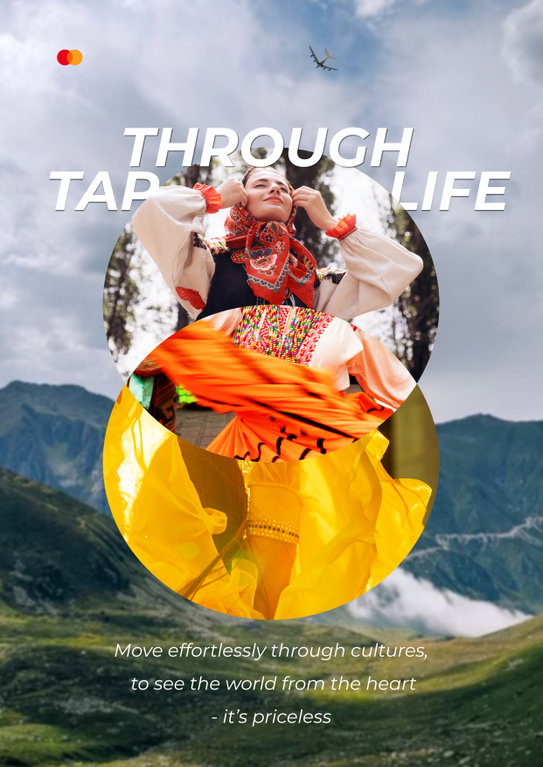
The Core Concept 'Tap Through Life' is about emotional freedom combined with moving smoothly. The creative revolves around a double meaning of the tapping action. It is both the effortless movement of making a contactless payment and the lively rhythm of dance. Dance is a way of self-expression through art you create with your body. It is smooth, freeing, and emotional, but at the same time has a sense of technicality where with the right form you are safe. Every traditional dance grows out of deep history and national roots. Dance is born straight from the heart, showing the true character of a nation and reflecting how each culture has evolved over time. Because these traditions keep changing and growing, they remain forever alive. By tapping into this movement, we tap through life to witness the true soul of different nations. The poster tells this story using Mastercard's symbolism of intersecting circles. We see dancers from across the world showing off their culture with all their heart. These rings cross seamlessly in iconic Mastercard colors, where the red and yellow blend into vibrant orange right where the dancers meet, just like transactions work without friction to bring people together. Why it Fits Mastercard The borders between travel disappear when the scary and technical aspects are simplified. When we start seeing how easy exploration can be, we yearn to step right into the heart of a culture. Getting to experience these rich traditions firsthand is truly priceless. The phrase 'Tap Through Life' captures this exact journey, proving that technology simply removes the obstacles so you can experience the world from within. How it Could Scale Across the World This idea scales globally because human roots and rhythms speak a universal language. People everywhere share the same emotional need to connect and understand other cultures. Visual Assets Photographic elements sourced from Pexels, used in accordance with the Pexels License.
Agency: Student, Baltic Film, Media and Arts School, Tallinn
Authors: Anette-Laura Porrmann