AI Is a Massive New Tool, but It Is Still a Tool
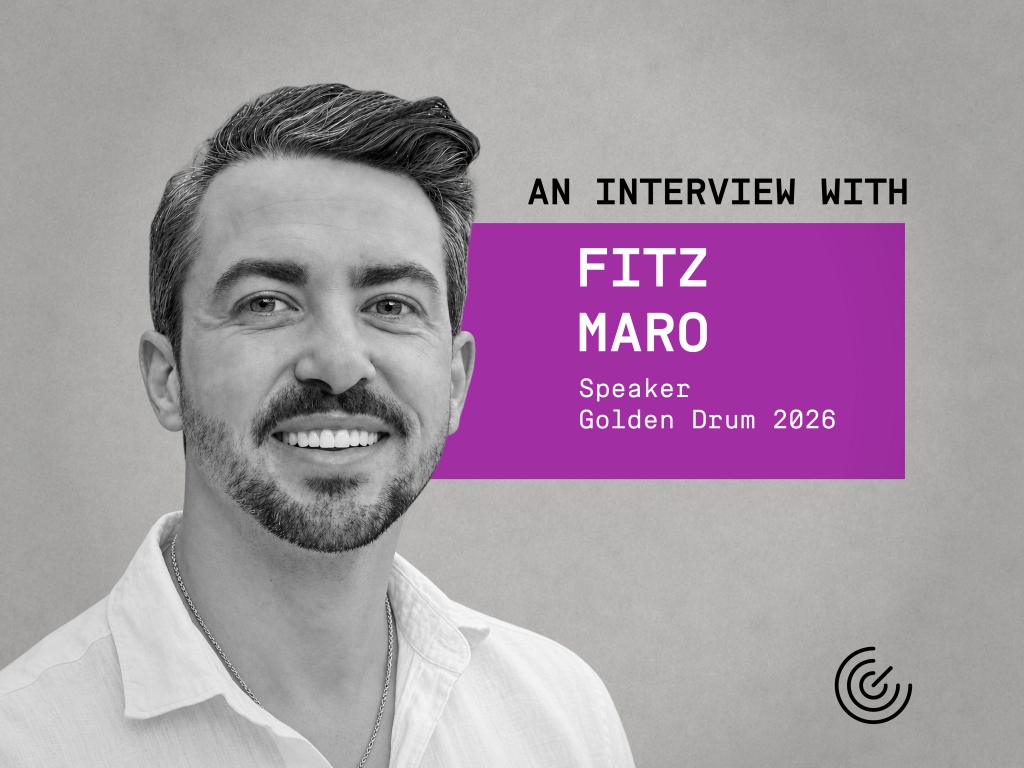
AI may be transforming how creative work gets made, but Fitz Maro believes it has not changed what it means to be creative. As Head of the Americas, Design Technology at Brand Innovation Lab, Amazon Ads, and a speaker at this year’s Golden Drum Festival, he has built his career at the intersection of ideas and emerging technology – exploring how new tools can expand creative possibilities without taking the place of creativity itself.
Ahead of his appearance in Portorož, he reflects on how AI can give creatives more time to do what they do best, why being first with new technology is not the same as innovating, and why curiosity, judgement and a strong idea remain at the heart of great creative work.
You’ve spent much of your career at the intersection of creativity and technology. Has AI fundamentally changed what it means to be a creative, or is it simply the latest tool in the creative toolbox?
I don’t think AI has fundamentally changed what it means to be a creative. The job is still to have a point of view, make good judgments and bring an idea to life with craft. AI is a massive new tool, and an unusually diverse one, but it is still a tool.
What has changed is how much of the process creatives can now take into their own hands. They can explore directions, build prototypes and remove friction from repetitive work without needing to become technical experts first. That gives them more ways to practice the craft they already have.
So the role hasn’t changed in my mind. The opportunity has. Creatives now have a crazy-big new tool for doing their best work and spending less time on everything surrounding it.
Your Golden Drum talk is titled “You Didn’t Join Advertising To Be A Machine.” What do you think creatives are spending too much of their time doing today—and what should they be doing instead?
Creatives are spending too much time on the logistics of the work instead of the work itself. Most people in advertising spend their sharpest hours on their dullest tasks: updating decks, answering emails, writing status updates, chasing follow-ups, resizing assets and managing endless rounds of small changes. Each task may be necessary, but together they consume an enormous amount of creative energy and mind space.
Creatives joined this industry to concept, apply their craft and make compelling work. That’s where their time and talent should be going.
My talk isn’t about handing creativity over to AI. It’s about building a second brain that handles everything but our craft: the routine communication, coordination and repetitive production surrounding the creative process. The future starts when AI handles that work, and Creatives can spend more time thinking, deciding and creating.
You’ve worked with emerging technologies long before the current AI boom, from AR and VR to voice experiences. What has that experience taught you about separating technologies that genuinely change creative possibilities from those that are mostly hype?
The "hype cycle" in our industry is real. People in advertising are especially vulnerable to its early phases because we want to be the first to use a new technology and beat everyone else to the punch. That desire often leads us to force the technology into an idea simply because it is the shiny new object.
Being first is not the same as innovating, and “new” alone is not enough. The test is whether the technology opens a genuine creative possibility and serves the big idea, or whether the idea is being contorted to justify the technology.
To put it simply: if the primary reason for using something is that no one else has used it yet, that’s usually a warning sign.
With technology evolving so quickly, how do you decide which new tools are actually worth learning and which ones you can safely ignore?
I don’t think you can safely ignore any of them without at least understanding what they are. That doesn’t mean becoming an expert in every new tool. It means staying curious enough to look, experiment and understand what each one might make possible.
That has never been easier. With AI, a new tool is a quick voice conversation away. What once took hours or days of research can now be compressed into seconds. That’s an incredibly powerful proposition for a curious mind.
Deciding which tools deserve deeper attention is a bit like walking through a gallery and deciding which art deserves more of your time. The answer is subjective and depends on what you’re trying to accomplish. But even the tools you don’t adopt become inputs. They help shape your understanding of what exists and where things may be going.
Do you think AI is making the creative industry more experimental, or is it actually encouraging people to produce more of the same?
Right now, I think AI is encouraging the industry to produce more of the same. Most of its visible use is about making familiar work faster and at greater volume. That has value, but it isn’t the part that excites me most.
What I’m watching is the emergence of genuinely creative technology ideas: experiences that weren’t possible six months ago, two months ago or even last week. AI is moving so quickly that each new model release is fundamentally shifting what’s possible.
The real opportunity comes when one of those new capabilities meets a big idea it can genuinely serve, and that idea strikes a cultural chord. When those pieces come together, AI can move beyond producing more content and help create work the industry simply couldn’t have made before.
Looking back at your career, was there a particular project, failure or unexpected opportunity that fundamentally changed the way you approach creative technology?
The unexpected opportunity that changed my thinking was moving from agencies to Pinterest. Until then, I thought about creative technology almost entirely through the lens of bespoke ideas: inventing something no one had seen before for one advertiser and one brief. The work could be incredible, but it usually disappeared when the campaign ended.
At Pinterest, I had to start thinking about impact at scale. The challenge was preserving what made an idea special while identifying the part that could become a reusable capability. Scale meant building something once that could unlock many different creative expressions, or remixes, of that idea.
I still care deeply about the magic of a bespoke idea, but I now ask another question much earlier: if this works, what part of it can keep creating value after the campaign ends?
If you were advising a brand today that wanted to take a genuinely creative risk, what would you tell them to do differently from the way brands traditionally approach innovation?
If a brand wants to take a genuinely creative risk, it has to accept that the idea may not arrive with a proven ROI. That’s what makes it a risk. Nothing genuinely new in this field is a sure thing. If you demand certainty before investing, you’ll keep approving versions of what has already worked.
That doesn’t mean being reckless. Invest enough to make the idea real, test it honestly and involve technologists from the beginning. Bringing them in after the concept has been approved usually results in technology being bolted onto an advertising idea. Bringing them in early helps shape an experience that makes sense, has a thoughtful user experience and offers people something genuinely delightful or valuable.
At some point, though, you have to go for it. You can’t innovate while requiring the answer in advance.
Looking at the work coming out of agencies and brands today, what’s one creative approach or behaviour you think is becoming overused, and what would you like to see replace it?
Borrowed interest, especially celebrity casting, feels completely played out to me. At least in the U.S., brands seem to grab whoever is trending, attach them to a campaign and treat that person’s relevance as a substitute for an idea.
A celebrity can absolutely belong in great work, but they need to be essential to the concept. In the same way you shouldn’t bolt technology onto an idea just to call it innovative, you shouldn’t bolt a celebrity onto one just to borrow their attention. If you could replace them with any other famous person and the idea stays the same, they probably were never part of the idea.
I’d like to see brands create work that earns attention on the strength of the idea itself. Then, if a specific person makes that idea possible or meaningfully better, bring them in. The celebrity should serve the idea, not be the idea.
The stage is set, the speakers are ready – secure your delegate pass, scroll the program, flag your must-see sessions, and get ready to experience Golden Drum 2026 in Portorož.